



Grade 9 geometry lesson
Bisecting an Angle: Meaning, Construction Steps, Examples, and Practice
Bisecting an angle means splitting one angle into two angles with equal measures.
What does it mean to bisect an angle?
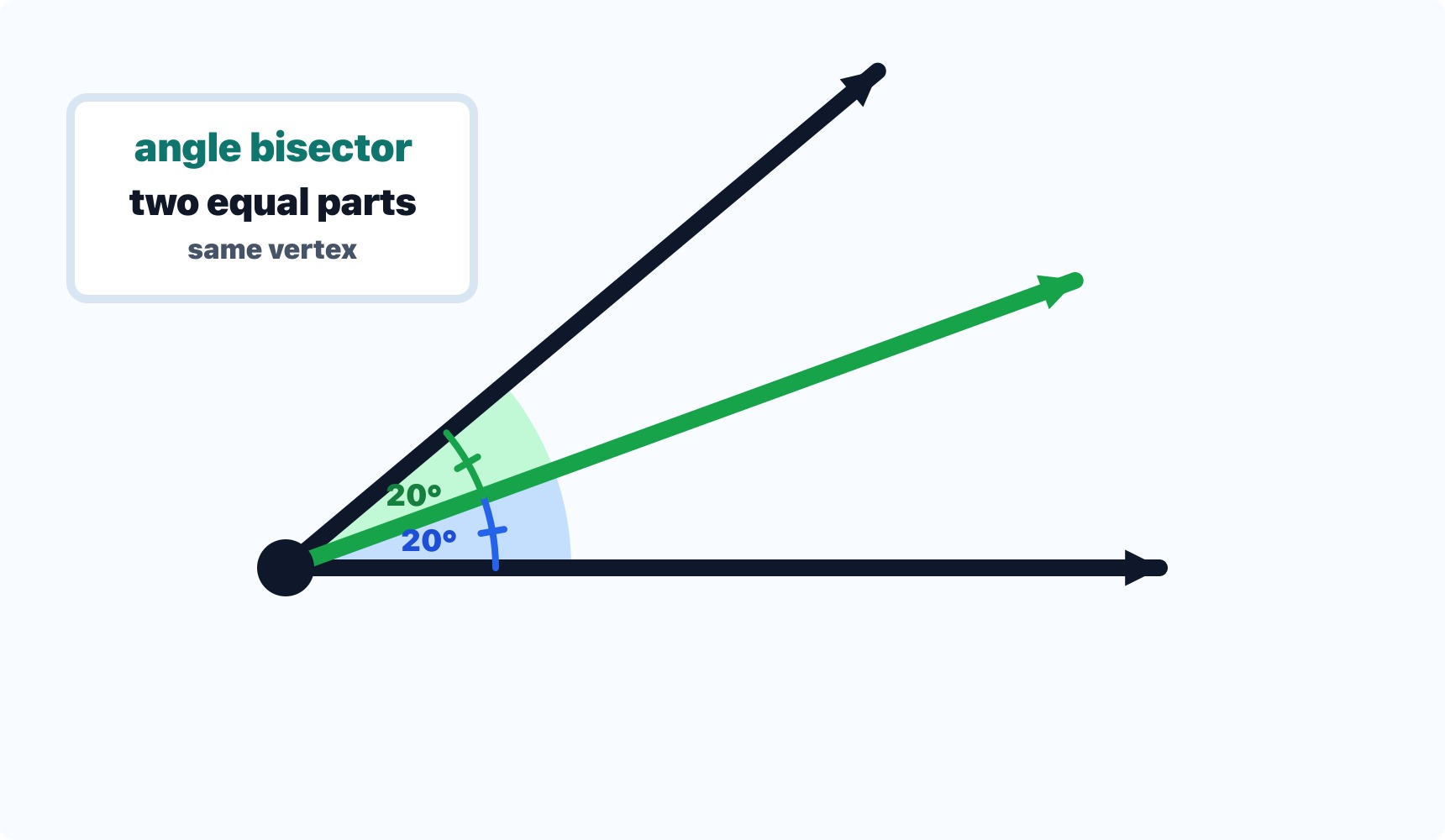
To bisect an angle means to cut the angle into two equal parts.
The ray that makes the cut is called an angle bisector.
If the original angle is 70°, the bisector makes two 35° angles.
The equal-split rule
A bisector starts at the same vertex as the original angle.
An angle bisector makes two smaller angles with the same measure.
The two smaller angles are adjacent angles because they sit next to each other and share the bisector ray.
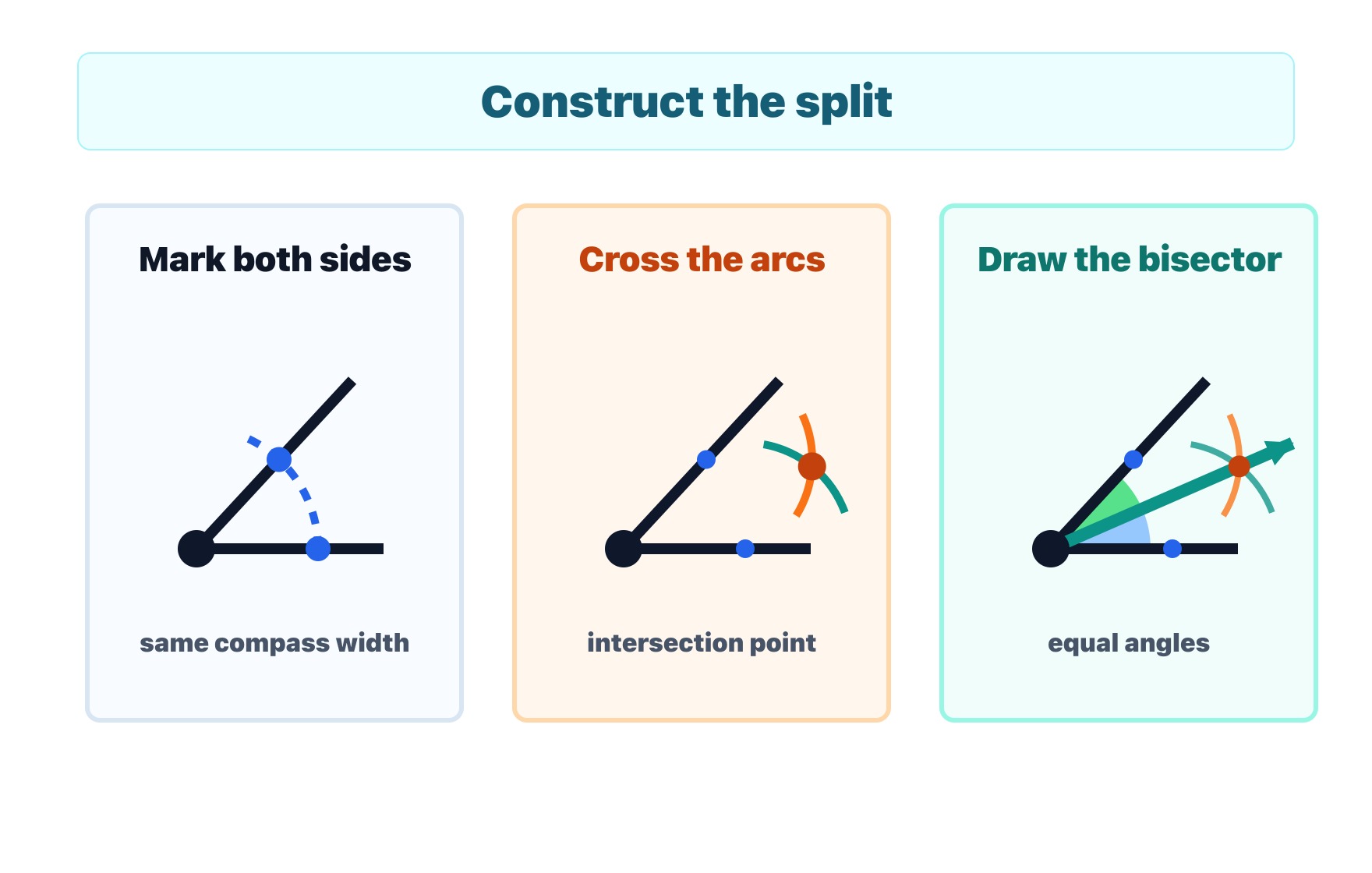
Construction chart: compass and straightedge
A formal construction uses a compass to copy distances and a straightedge to draw the final ray.
The goal is not to guess the middle. The compass marks two equal paths so the bisector lands in the correct place.
Example: bisect a 72° angle
Problem: An angle measures 72°. A ray bisects it. What are the two new angle measures?
Step 1: Bisect means split into two equal parts.
Step 2: Divide 72° by 2.
Step 3: 72° ÷ 2 = 36°.
Answer: The bisector makes two 36° angles.
Compass construction steps
1. Put the compass point on the vertex and draw an arc that crosses both sides of the angle.
2. Keep the same compass opening. From each crossing point, draw a small arc inside the angle.
3. Mark where the two small arcs meet.
4. Use a straightedge to draw a ray from the vertex through that meeting point.
Errors that make uneven halves
Do not draw a line that only looks centered. A true bisector makes equal angle measures.
Do not move the compass width between the two small inside arcs during construction.
Do not start the bisector from a different point. The bisector ray must begin at the original vertex.
Practice: spot the equal halves
1. A 50° angle is bisected. Each smaller angle is 25°.
2. A ray makes angles of 31° and 31° inside a larger angle. The ray is an angle bisector.
3. A ray makes angles of 40° and 43°. It is not a bisector.
4. A bisector of a right angle makes two 45° angles.
Interactive playground
Split one angle into equal parts
Change the original angle. The middle ray keeps both smaller angles equal.