



Grade 3 multiplication lesson
Associative Property of Multiplication: Meaning, Examples, Chart, and Quiz
The associative property of multiplication says that when multiplying three or more numbers, you can change the grouping and the product stays the same.
What is the associative property of multiplication?
The associative property of multiplication is a rule about grouping.
It says that when you multiply three or more numbers, you can group the factors in different ways and still get the same product.
In plain words: grouping changes, but the answer does not change.
Printable associative property chart
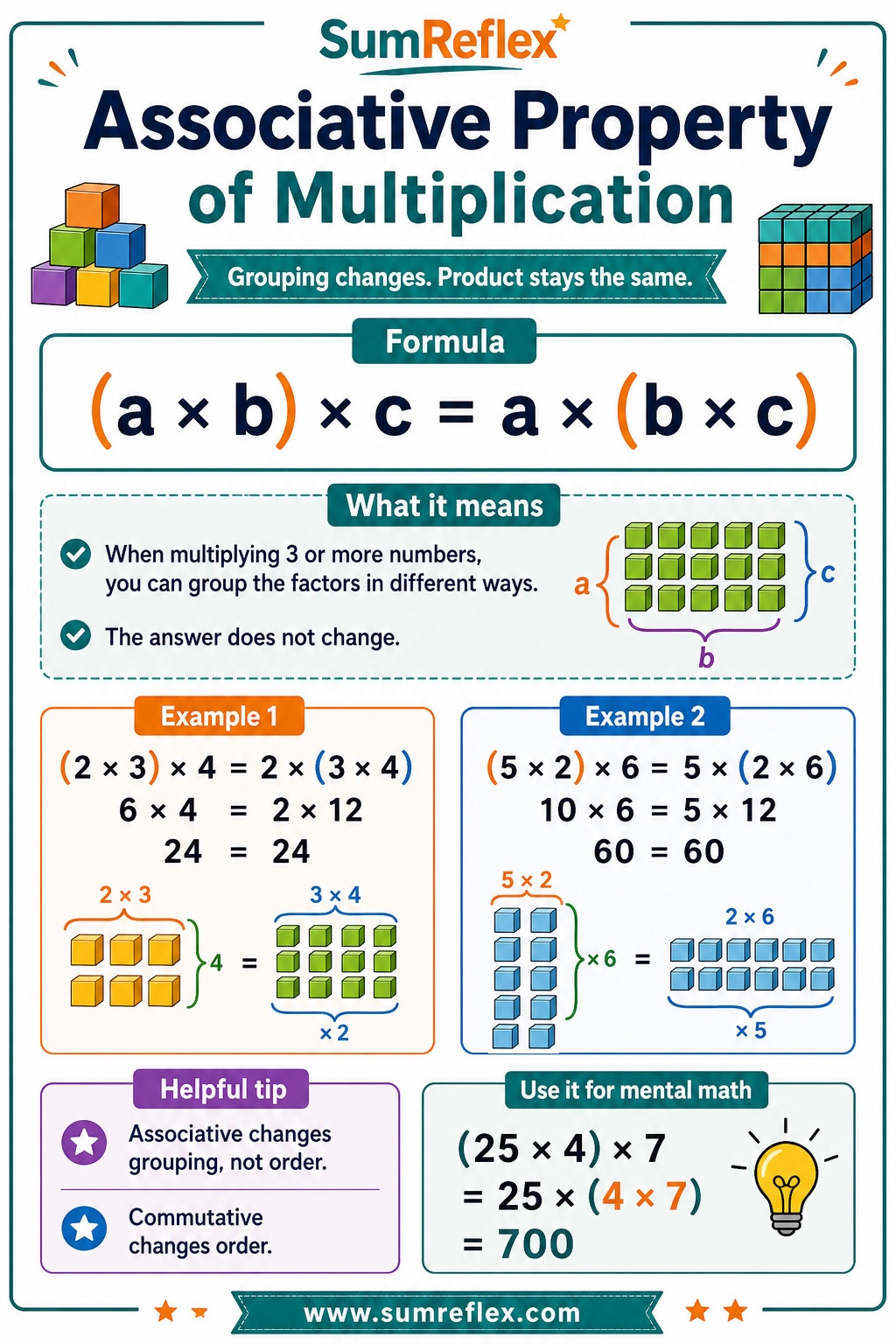
Use this SumReflex chart as a quick reminder of the formula, the meaning, and two clear examples.
The same chart is also available in the dedicated Printable Math Solving Charts section with print and download buttons.
The formula
The formula is (a × b) × c = a × (b × c).
The letters a, b, and c stand for any numbers you are multiplying.
The parentheses show which two factors are grouped first. In the first expression, a and b are grouped. In the second expression, b and c are grouped.
Even though the grouping changes, the final product is the same.
What parentheses mean in this property
Parentheses tell you what to do first.
In (2 × 3) × 4, multiply 2 × 3 first. That gives 6, then 6 × 4 = 24.
In 2 × (3 × 4), multiply 3 × 4 first. That gives 12, then 2 × 12 = 24.
Both ways give 24, so the expressions are equal.
Example 1: same factors, different grouping
Look at (2 × 3) × 4 and 2 × (3 × 4).
First grouping: (2 × 3) × 4 = 6 × 4 = 24.
Second grouping: 2 × (3 × 4) = 2 × 12 = 24.
The factors are still 2, 3, and 4. Only the grouping changed.
Example 2: grouping can make mental math easier
Sometimes the associative property helps you choose friendlier numbers.
For example, (25 × 4) × 7 is easy because 25 × 4 = 100. Then 100 × 7 = 700.
You can also see the same idea as 25 × (4 × 7). The grouping changes, but the product is still 700.
A helpful habit is to look for facts that make 10, 100, or another easy product.
Example 3: three factors
(5 × 2) × 6 = 5 × (2 × 6).
Left side: (5 × 2) × 6 = 10 × 6 = 60.
Right side: 5 × (2 × 6) = 5 × 12 = 60.
Both expressions equal 60, so the associative property works.
Example 4: four factors
The associative property is not limited to three factors. It can help with four or more factors too.
Example: 2 × 5 × 3 × 4.
You could group it as (2 × 5) × (3 × 4). That gives 10 × 12 = 120.
You could also group it as 2 × (5 × 3) × 4. That gives 2 × 15 × 4 = 120.
The product is still 120 because the factors did not change.
Associative property vs. commutative property
The associative property changes the grouping. The order of the factors stays the same.
Example: (3 × 4) × 5 = 3 × (4 × 5). The factors stay in the order 3, 4, 5.
The commutative property changes the order. Example: 3 × 4 = 4 × 3.
A short way to remember it: associative is about parentheses; commutative is about switching places.
Why it works
Multiplication is repeated equal groups. Changing the grouping does not change how many items there are altogether.
Imagine 2 rows, 3 columns, and 4 layers of blocks. You can count 2 × 3 first, then multiply by 4. Or you can count 3 × 4 first, then multiply by 2.
Either way, you are counting the same complete set of blocks. That is why the total stays the same.
Many more examples
(3 × 2) × 5 = 3 × (2 × 5). Both sides equal 30.
(4 × 5) × 2 = 4 × (5 × 2). Both sides equal 40.
(6 × 2) × 3 = 6 × (2 × 3). Both sides equal 36.
(8 × 5) × 2 = 8 × (5 × 2). Both sides equal 80.
(10 × 7) × 3 = 10 × (7 × 3). Both sides equal 210.
(12 × 5) × 2 = 12 × (5 × 2). Both sides equal 120.
How to use it in word problems
Suppose there are 4 boxes. Each box has 3 bags. Each bag has 5 marbles.
You can group the calculation as (4 × 3) × 5: first find 4 boxes × 3 bags = 12 bags, then 12 × 5 = 60 marbles.
You can also group it as 4 × (3 × 5): first find 3 bags × 5 marbles = 15 marbles per box, then 4 × 15 = 60 marbles.
Both methods describe the same situation, so both give 60 marbles.
Common mistakes
Do not change the order and call it associative. If the factors move places, you are using the commutative property too.
Do not change one of the factors. For example, (2 × 3) × 4 is not the same as 2 × (3 × 5).
Do not forget that parentheses only show grouping. They do not create a new number by themselves.
Do not use the associative property with subtraction or division in the same way. Multiplication has this property, but subtraction and division do not.
Quick check before the quiz
If you see three factors and parentheses move from the first two factors to the last two factors, that is the associative property of multiplication.
(7 × 2) × 5 = 7 × (2 × 5) is associative because only the grouping changed.
7 × 2 = 2 × 7 is commutative because the order changed.
Now try the quiz below. It will ask you to choose matching grouped expressions and calculate products.
Practice quiz
Associative property quiz
Choose the expression or product that matches the same multiplication with a different grouping.
Look for the same factors in the same order. Only the parentheses should move.
Choose an answer to check your thinking.