



Grade 10 geometry lesson
Circle Angle: Rules, Theorems, Examples, Chart, and Practice
Circle angle rules help you find missing angles by looking at where the angle starts and which arc it uses.
What is a circle angle?
A circle angle is any angle connected to a circle, its center, its edge, its chords, its tangents, or its arcs.
The main idea is simple: the angle and the arc are linked. If you can see which arc the angle opens toward, you can usually find the missing angle.
In circle geometry, the first question is not "What formula should I use?" The first question is "Where is the vertex?" The vertex location tells you the rule.
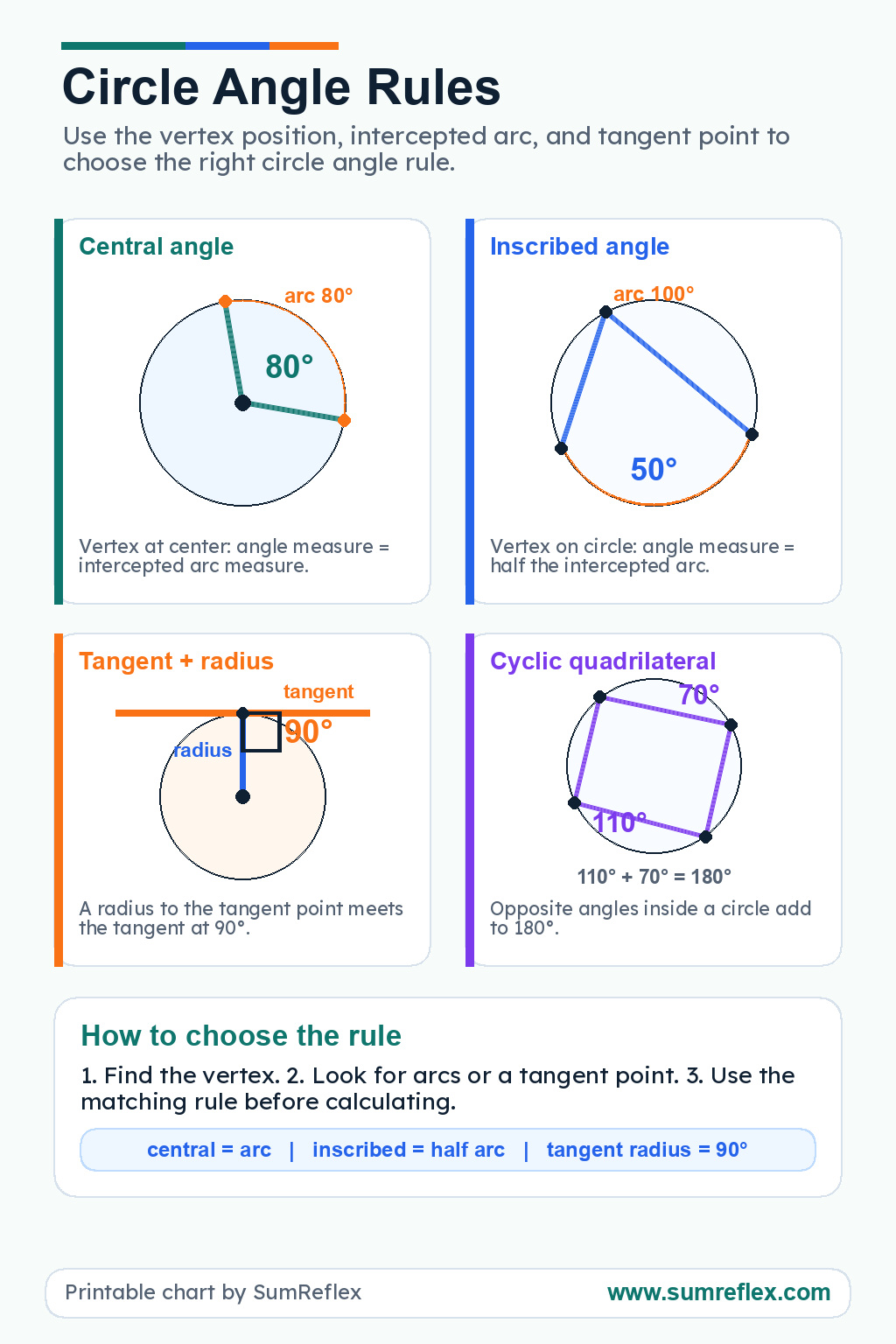
Printable circle angle rules chart
Use this chart as a quick reference for the four rules students meet most often: central angle, inscribed angle, tangent with radius, and cyclic quadrilateral angles.
The chart is also available in the printable chart section for quick classroom reference.
Words to know before using circle angle rules
Center: the exact middle point of the circle.
Radius: a line segment from the center to the circle.
Diameter: a line segment across the circle through the center. A diameter is twice the radius.
Chord: a line segment with both endpoints on the circle.
Arc: part of the curved edge of the circle.
Tangent: a line that touches the circle at exactly one point.
Cyclic quadrilateral: a four-sided shape with all four vertices on the same circle.
Rule 1: central angle
A central angle has its vertex at the center of the circle.
Central angle = intercepted arc.
Example: If a central angle is 72°, then the arc it intercepts is also 72°.
Example: If the intercepted arc is 140°, then the central angle is 140°.
This is the most direct circle angle rule because the angle starts from the center.
Rule 2: inscribed angle
An inscribed angle has its vertex on the circle. Its sides are usually chords.
Inscribed angle = half of the intercepted arc.
Example: If an inscribed angle intercepts a 100° arc, the angle is 50°.
Example: If an inscribed angle is 35°, the intercepted arc is 70° because the arc is twice the angle.
This is one of the most common places students make a mistake. If the vertex is on the circle, divide the arc by 2.
Rule 3: angle in a semicircle
A semicircle is half of a circle, so its arc measure is 180°.
If an inscribed angle intercepts a diameter, it intercepts a semicircle.
An angle in a semicircle is always 90°.
Example: Points A and B are endpoints of a diameter. Point C is on the circle. Angle ACB is 90°.
This rule is really the inscribed angle rule: half of 180° is 90°.
Rule 4: angles in the same segment
Two inscribed angles that open toward the same arc are equal.
Example: Angle ACB and angle ADB both intercept arc AB. If angle ACB is 42°, then angle ADB is also 42°.
This rule is helpful when a diagram looks crowded. If two angles stand on the same chord or same arc, they match.
Rule 5: cyclic quadrilateral
A cyclic quadrilateral is a four-sided shape inside a circle with all four corners on the circle.
Opposite angles in a cyclic quadrilateral add to 180°.
Example: If one angle is 110°, the opposite angle is 70° because 110° + 70° = 180°.
Example: If one angle is 84°, the opposite angle is 96° because 180° - 84° = 96°.
Rule 6: tangent and radius
A circle tangent touches the circle at one point.
A radius drawn to the point of tangency meets the tangent at 90°.
Example: A tangent touches the circle at T, and radius OT is drawn. Angle between OT and the tangent line is 90°.
This rule is often used with triangles. If the radius and tangent make a right angle, you can use right-triangle facts to find other angles.
Rule 7: tangent-chord angle
The tangent-chord rule connects a tangent line with a chord drawn from the point of tangency.
The angle between a tangent and a chord equals the angle in the opposite arc.
Example: A tangent touches the circle at A, and chord AB is drawn. If the angle between the tangent and chord AB is 48°, then the angle standing on chord AB in the opposite part of the circle is also 48°.
A short way to remember it: tangent plus chord equals the angle in the alternate segment.
Rule 8: two chords crossing inside a circle
Sometimes two chords cross inside the circle. The angle at the crossing point is not just one arc.
Angle inside the circle = half the sum of the intercepted arcs.
Example: Two chords cross inside a circle. The intercepted arcs are 90° and 50°. The angle is half of 90° + 50°, so the angle is 70°.
Calculation: (90 + 50) / 2 = 140 / 2 = 70°.
Rule 9: two secants or tangents outside a circle
When the angle is outside the circle, use the difference of the arcs.
Angle outside the circle = half the difference of the intercepted arcs.
Example: Two secants meet outside a circle. The far arc is 130° and the near arc is 50°. The outside angle is half of 130° - 50°, so it is 40°.
Calculation: (130 - 50) / 2 = 80 / 2 = 40°.
The outside-angle rule feels different because the two lines meet outside the circle, so you subtract instead of add.
How to choose the correct rule
If the vertex is at the center: use central angle = arc.
If the vertex is on the circle: use inscribed angle = half the arc.
If the angle uses a diameter: look for a 90° angle in a semicircle.
If the shape is a cyclic quadrilateral: opposite angles add to 180°.
If there is a tangent and a radius: the angle at the touch point is 90°.
If two chords cross inside: half the sum of the arcs.
If two lines meet outside: half the difference of the arcs.
Worked example 1: central angle
Problem: A central angle intercepts an arc of 126°. What is the central angle?
The vertex is at the center, so the central angle equals the intercepted arc.
Answer: 126°.
Worked example 2: inscribed angle
Problem: An inscribed angle intercepts a 156° arc. Find the angle.
An inscribed angle is half its intercepted arc.
156° / 2 = 78°.
Answer: 78°.
Worked example 3: find the arc from the angle
Problem: An inscribed angle is 64°. What is the intercepted arc?
The arc is twice the inscribed angle.
64° × 2 = 128°.
Answer: 128°.
Worked example 4: cyclic quadrilateral
Problem: A cyclic quadrilateral has one angle measuring 73°. Find the opposite angle.
Opposite angles in a cyclic quadrilateral add to 180°.
180° - 73° = 107°.
Answer: 107°.
Worked example 5: two chords crossing inside
Problem: Two chords cross inside a circle. The intercepted arcs are 112° and 68°. Find the angle at the crossing point.
Use half the sum of the arcs.
(112° + 68°) / 2 = 180° / 2 = 90°.
Answer: 90°.
Worked example 6: outside angle
Problem: Two secants meet outside a circle. The intercepted arcs are 160° and 64°. Find the outside angle.
Use half the difference of the arcs.
(160° - 64°) / 2 = 96° / 2 = 48°.
Answer: 48°.
A tougher example with more than one step
Problem: A cyclic quadrilateral has angles labeled x, 82°, y, and 98° in order around the circle. Find x and y.
Opposite angles add to 180°.
x is opposite 98°, so x + 98° = 180°. That means x = 82°.
y is opposite 82°, so y + 82° = 180°. That means y = 98°.
Answer: x = 82° and y = 98°.
Notice that the opposite pairs switch. This is why it helps to mark opposite angles before calculating.
Common mistakes
Do not use the inscribed angle rule when the vertex is at the center. A central angle is not half the arc.
Do not forget that a tangent and radius make 90° only at the point where the tangent touches the circle.
Do not add opposite angles in a normal quadrilateral and assume they make 180°. That is only guaranteed when the quadrilateral is cyclic.
Do not mix up the inside and outside formulas. Chords crossing inside use half the sum. Lines meeting outside use half the difference.
Do not confuse arc measure with arc length. Arc measure is in degrees. Arc length is a distance.
Quick quiz
1. A central angle intercepts a 92° arc. What is the angle? Answer: 92°.
2. An inscribed angle intercepts a 118° arc. What is the angle? Answer: 59°.
3. An inscribed angle is 41°. What is the intercepted arc? Answer: 82°.
4. A cyclic quadrilateral has an angle of 115°. What is the opposite angle? Answer: 65°.
5. A radius meets a tangent at the point of tangency. What is the angle? Answer: 90°.
6. Two chords cross inside a circle. The intercepted arcs are 70° and 130°. What is the angle? Answer: 100°.
7. Two secants meet outside a circle. The intercepted arcs are 150° and 42°. What is the outside angle? Answer: 54°.
8. An angle stands on a diameter inside a circle. What is the angle? Answer: 90°.