



Grade 1 addition lesson
Commutative Property of Addition: Meaning, Formula, Examples, and Chart
The commutative property of addition says that changing the order of addends does not change the sum.
What is the commutative property of addition?
The commutative property of addition is a rule about order.
It says that when you add two numbers, you can switch the order of the addends and the sum stays the same.
In simple words: order changes, but the answer does not change.
Printable commutative addition chart
Use this SumReflex chart as a quick reminder of the formula, meaning, vocabulary, examples, and the subtraction warning.
The same chart is also available in the Printable Math Solving Charts section with print and download buttons.
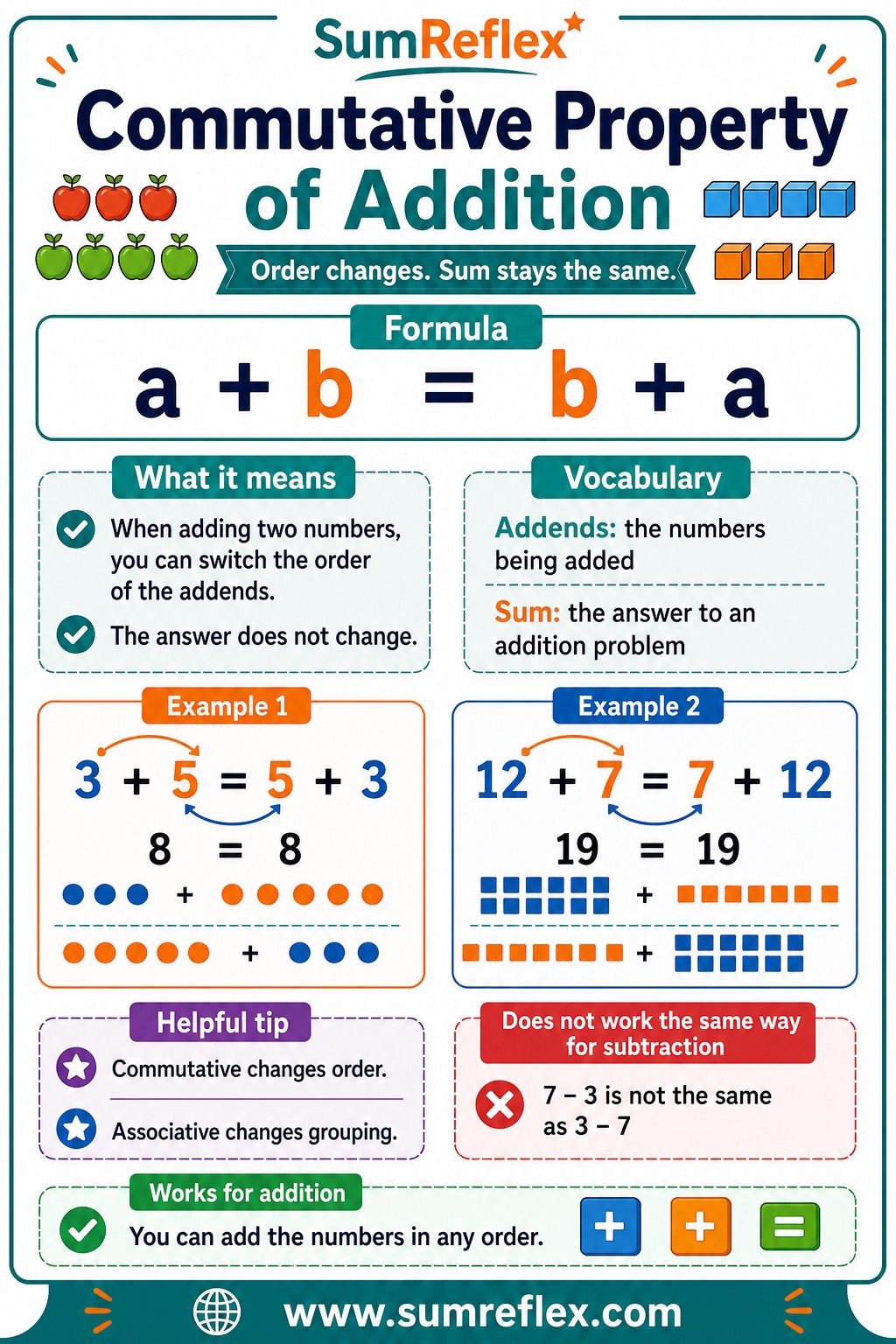
The formula
The formula is a + b = b + a.
The letters a and b stand for any two numbers.
The left side adds a first and b second. The right side adds b first and a second.
The order is different, but both sides have the same sum.
Important vocabulary
An addend is a number that is being added.
A sum is the answer to an addition problem.
In 3 + 5 = 8, the addends are 3 and 5, and the sum is 8.
If you switch the addends, you get 5 + 3 = 8. The sum is still 8.
Why the rule works
Think about 3 apples and 5 apples. You have 8 apples altogether.
If you count the 5 apples first and then the 3 apples, you still have 8 apples altogether.
The objects did not change. Only the counting order changed.
That is the main idea behind the commutative property of addition.
Example 1: small numbers
3 + 5 = 5 + 3.
Left side: 3 + 5 = 8.
Right side: 5 + 3 = 8.
Both sides equal 8, so the equation is true.
Example 2: two-digit numbers
12 + 7 = 7 + 12.
Left side: 12 + 7 = 19.
Right side: 7 + 12 = 19.
The addends switched places, but the sum stayed 19.
Example 3: adding zero
The commutative property also works with zero.
9 + 0 = 0 + 9.
Both sides equal 9.
Zero does not add anything, so the sum stays the same either way.
Example 4: bigger numbers
46 + 28 = 28 + 46.
Left side: 46 + 28 = 74.
Right side: 28 + 46 = 74.
When the numbers get bigger, switching the order can still be helpful because the answer remains the same.
How it helps with mental math
Sometimes one order feels easier than another.
8 + 30 may be easier to think of as 30 + 8, which is 38.
4 + 97 may be easier to think of as 97 + 4, which is 101.
6 + 200 may be easier to think of as 200 + 6, which is 206.
The property lets you choose the order that is easiest for your brain.
More number examples
2 + 9 = 9 + 2. Both sides equal 11.
14 + 6 = 6 + 14. Both sides equal 20.
25 + 10 = 10 + 25. Both sides equal 35.
31 + 19 = 19 + 31. Both sides equal 50.
100 + 45 = 45 + 100. Both sides equal 145.
250 + 75 = 75 + 250. Both sides equal 325.
Word problem example
Maya has 6 blue stickers and 9 red stickers. She has 6 + 9 = 15 stickers.
Leo counts the same stickers by saying 9 red stickers and 6 blue stickers. That is 9 + 6 = 15.
Both children are counting the same total. They just started with a different group.
This is the commutative property of addition in a real situation.
Commutative property vs. associative property
The commutative property changes the order of the addends.
Example: 4 + 7 = 7 + 4.
The associative property changes the grouping of addends when there are three or more numbers.
Example: (2 + 3) + 5 = 2 + (3 + 5).
A simple way to remember it: commutative is about switching places; associative is about moving parentheses.
Does it work for subtraction?
No. The commutative property does not work the same way for subtraction.
7 - 3 and 3 - 7 are not the same subtraction situation.
The starting amount changes, so the answer does not stay the same.
So it is safe to switch order in addition, but not in subtraction.
Common mistakes
Do not change one of the numbers. 8 + 5 can switch to 5 + 8, but not to 5 + 9.
Do not call every addition shortcut commutative. If you are grouping three numbers with parentheses, you may be using the associative property too.
Do not use the rule with subtraction just because subtraction looks like a related operation.
Do not forget to check the sum on both sides when you are proving the property.
Mini quiz
1. Fill in the blank: 4 + 11 = 11 + ___. Answer: 4.
2. Fill in the blank: 25 + 9 = ___ + 25. Answer: 9.
3. True or false: 6 + 8 = 8 + 6. Answer: true.
4. True or false: 10 - 2 = 2 - 10. Answer: false.
5. What is the sum of both 17 + 3 and 3 + 17? Answer: 20.
6. Which property switches the order of addends? Answer: the commutative property of addition.
The big idea
The commutative property of addition is one of the first math properties students use every day.
It tells us that addends can switch places and the sum will stay the same.
Once this feels natural, students can use it to check answers, solve mentally, and understand why addition is flexible.